-
tel:
+86-13606193016 -
email:
info@suhangmachine.com

Hydraulic Cutting vs. Saw Cutting for Roll Formed Steel Profiles
Oct 29, 2026
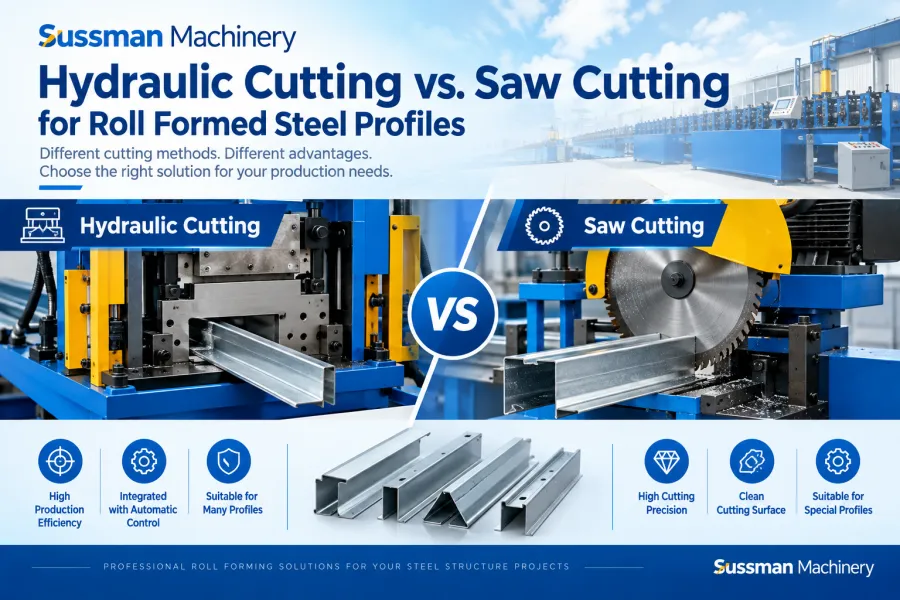
Cutting is an important stage in roll forming production. After steel passes through the forming stations, it must be cut to the required length and meet the dimensional and edge-quality requirements of the finished product.
Hydraulic cutting and saw cutting are two methods used in metal profile manufacturing. Each has different characteristics, and the appropriate solution depends on the material, profile geometry, production speed, and required cutting quality.
For manufacturers planning a new roll forming line, understanding these differences can help clarify the technical requirements before ordering equipment.
1. How Hydraulic Cutting Works
Hydraulic cutting uses hydraulic power to operate a cutting blade or die. Depending on the machine design, the cutting system can be integrated into a roll forming line to cut profiles to predetermined lengths.
Hydraulic cutting is commonly used for many cold-formed steel profiles, including purlins, framing components, metal roofing panels, and other products designed for shearing.
Potential advantages include:
-
Integration with automatic length measurement and control
-
A compact cutting arrangement in suitable machine configurations
-
No saw blade required for the shearing operation
-
Efficient cutting of compatible profiles in repetitive production
However, the cutting die must match the profile geometry and material specifications. Blade clearance, cutting force, and tool condition all affect the final result.
2. How Saw Cutting Works
Saw cutting removes material using a rotating saw blade. Depending on the equipment and blade selected, it can be suitable for profiles that require a particular cut quality or cannot be processed appropriately with conventional shearing.
Important considerations include:
-
Profile shape and dimensions
-
Material thickness and mechanical properties
-
Blade type and cutting parameters
-
Required end-face quality
-
Cutting speed and production volume
-
Chip removal and blade maintenance
The suitability of saw cutting should be evaluated for the specific product rather than assumed from the profile's general appearance.
3. Comparing the Two Cutting Methods
Cutting principle: Hydraulic cutting generally separates material through shearing, while saw cutting removes material through a rotating blade.
Edge condition: Shearing can produce burrs or localized deformation if the tooling or clearance is unsuitable. Saw cutting can produce its own edge characteristics depending on blade selection, feed conditions, and material.
Production integration: Hydraulic cutting can be integrated into automated roll forming lines. Saw cutting can also be automated, but the appropriate arrangement depends on the equipment design and production process.
Maintenance: Hydraulic cutting requires attention to blades, hydraulic components, and cutting tooling. Saw cutting requires attention to blade wear, cutting parameters, and chip management.
Cost considerations: The total operating cost depends on tooling consumption, maintenance, production speed, material utilization, and the quality requirements of the finished product.
Neither method is automatically the best choice for every application.
4. Questions to Answer Before Selecting a Cutting System
Before specifying a cutting system, buyers should clarify several points:
-
What is the exact profile cross-section?
-
What are the material grade and thickness range?
-
What cut length and dimensional tolerance are required?
-
Are there special requirements for the end face or edge condition?
-
What production speed is needed?
-
Will the cutting operation run automatically with the roll forming line?
These details help equipment manufacturers assess the appropriate cutting method and configuration.
Conclusion
Hydraulic cutting and saw cutting serve different production needs. The correct choice depends on the profile design, material properties, cutting quality, and production requirements.
At Sussman Machinery, cutting-system requirements can be discussed as part of a customized roll forming project. Customers are encouraged to provide profile drawings, material specifications, and cut-length requirements for technical evaluation.
Contact Sussman Machinery to discuss the cutting solution for your steel profile production line.

Related News

October 26, 2016
The Most Successful Engineering Contractor

Contact US
Product Information
Quantity
Unit
Piece
Support order samples, customization, wholesale direct, and complete payment. If the product you look for does not have corresponding customized content, pls fill out the form below to contact us, and we will reply ASAP.